How to Select Food Coloring for Drinks Based on Product Requirements
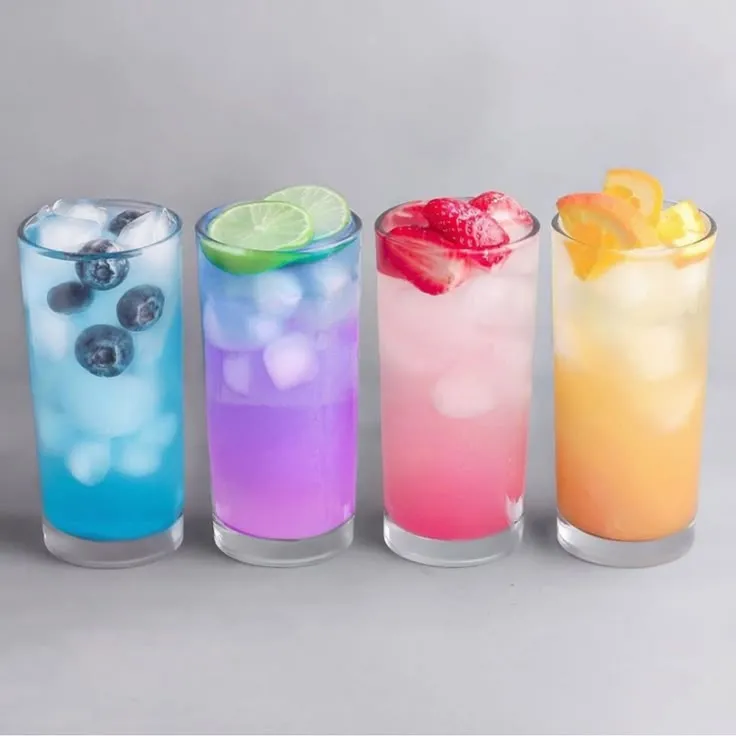
Choosing a food coloring to color a drink isn’t just a question of picking a color that looks good in a sample. Ingredients (acids, minerals, flavors, sweeteners, and others) in drinks can affect color performance. The appearance can also vary due to processing and storage conditions. Beverage manufacturers, therefore, must carefully review the color based on the whole formulation, process, packaging, and storage time prior to commercial production.
Start With the Beverage Formula
Understanding the formulation of the drink is the first step. The dispersion and appearance of a natural color can be affected by the acidity, sugar concentration, minerals, oils, proteins, etc.
The desired color tone should be well-defined as well. Depending on the product and market positioning, a manufacturer may desire a bright, light, deep or muted color.
Product developers should consider the color of the ingredient after it has been diluted into the target beverage formulation and not the concentrated form.
Consider Solubility and Dispersion
A good color should be evenly dispersed in the beverage. The appearance, sedimentation and/or sighting of particles may be inconsistent if poor dispersion occurs, depending on the formulation.
When choosing food coloring for drinks, manufacturers should review whether the ingredient is water-soluble, dispersible, emulsified, or supplied in another suitable format.
The beverage system should correspond to the physical format. There are distinct needs for adding color to drinks that are clear, cloudy, dairy products or oil-based foods.
Evaluate pH Conditions
The acidity, or pH, may be a factor in your choice of natural color, as many drinks are acidic. The acidity of the formulation may alter the color and/or stability of some pigments.
Therefore, manufacturers need to test the color at the pH that they intend to use, not at a generic pH.
When the formulation is liable to change as it is being developed, it can also be helpful to assess the color over a practical pH range. This will help to understand the sensitivity the ingredient might be to formulation changes.
Consider Spirulina Extract Color
Spirulina Extract Color is a natural blue color that can be used in certain beverages. May be useful for producing blue shades and could also be relevant for manufacturers who wish to produce green shades by appropriate color combination.
The color obtained from spirulina is dependent on the matrix of the beverage and the processing conditions. During application testing, it is important to evaluate factors including acidity, exposure to heat, light and storage.
The color of the finished product should be determined after addition of the ingredient in the finished beverage, not from the concentrated color alone.
Check Processing Conditions
Mixing, heating, pasteurization, filling or other processing steps may be used for the production of beverages. These conditions may affect the final color of the natural colors.
Manufacturers need to determine the most critical processing phase and incorporate it in lab testing. This can help identify if the chosen color will retain the desired colour post processing.
Additional information can be found with storage testing. The color may be affected by light, temperature, oxygen and packaging during the product’s intended shelf life.
Match Color to Packaging
Packaging can affect consumers’ perception of the color of a beverage. Clear containers will keep the product visible but may also allow light to penetrate the container, exposing the color.
Thus, the following factors should be taken into account when assessing stability: conditions of packaging. Colors that are suitable in lab conditions might have to be re-evaluated under commercial storage and display conditions.
This means packaging is an integral part of the selection of color, not a stand-alone issue.
Test Before Commercial Production
A fair comparison of colors to be applied should be done under the same conditions. Shade, dosage and dispersion, processing response, and post-storage appearance can be assessed by product developers.
Testing a variety of concentrations can also be helpful, so you can see how much concentration is needed to get the desired shade. Maintain the same conditions for the trials to make comparisons accurate and help to make decisions on the choice of ingredients.
Conclusion
Formulation, pH, dispersion, processing, packaging, storage and the final appearance are all important factors when choosing a natural color for drinks. Color in a sample color that is “right” for a beverage needs to perform well when it is introduced into the finished beverage system. For manufacturers seeking solutions in naturally colored beverages, they can consult with FoodRGB.com to find color solutions and meet with a knowledgeable technical partner to discuss unique beverage formulation needs.